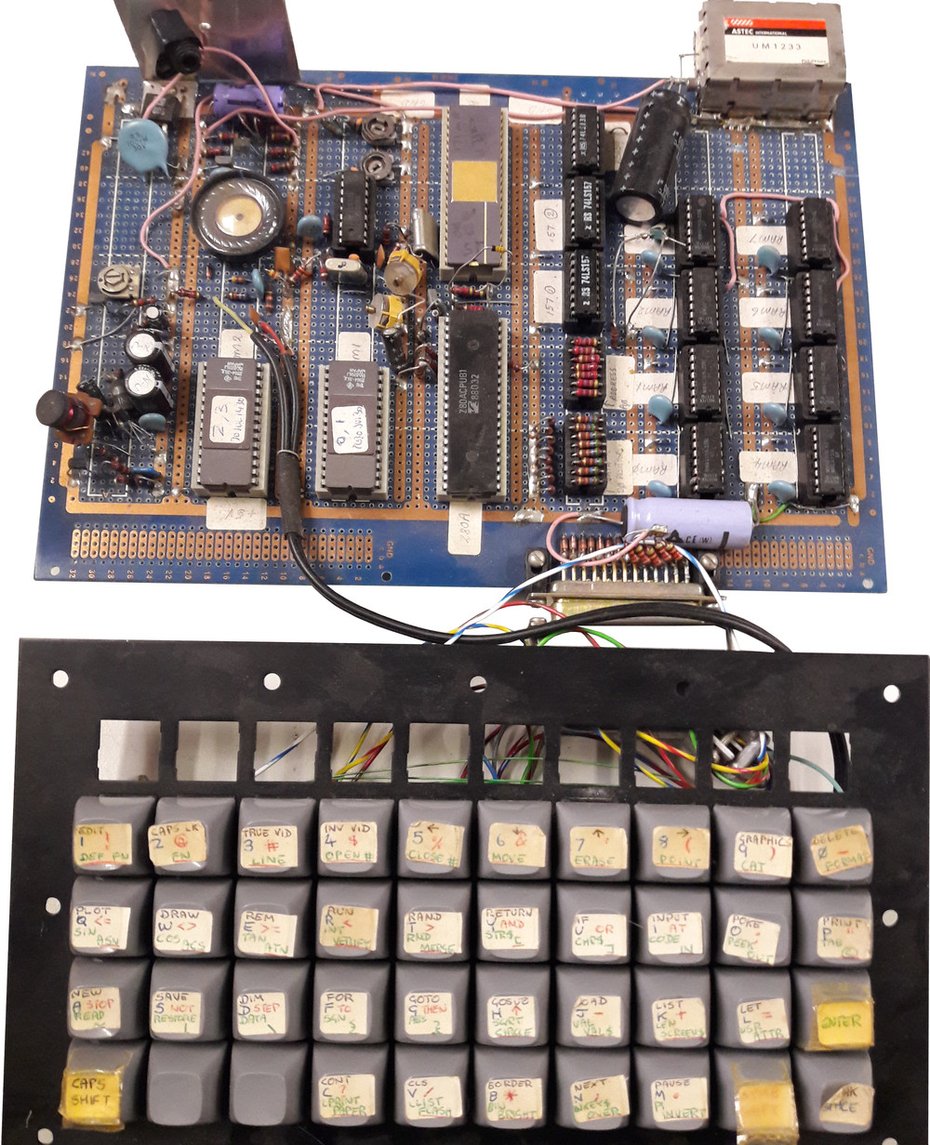
Sinclair ZX Spectrum Prototype, late 1981
The ZX Spectrum played a starring role in the history of personal computing and video gaming. Later fame came at the price of difficult development.
Cambridge company Nine Tiles were subcontracted to produce the Spectrum’s BASIC ROM. They had produced the code for the ZX80 and ZX81 but wanted to rewrite it for the new machine. There was neither the time nor resources, however, and Nine Tiles complained that Clive Sinclair wanted the maximum new facilities for the minimum money. The new BASIC took a year to write and proved to be very slow. Financial disagreements came to a head between Sinclair and Nine Tiles in February 1982. As a result, Sinclair launched the Spectrum with an unfinished ROM.
Nine Tiles continued to work on it until 3 months after the Spectrum's launch, but by then too many machines had shipped. The new code and this prototype were no longer needed.
This prototype has a full travel keyboard with the commands hand written on the top. All the chips are labelled, and the underside of the board is all hand wrap wiring.
The layout has familiar components, but is very different from the Spectrum's final configuration.
By clicking “Accept All Cookies”, you agree to the storing of cookies on your device to enhance site navigation, analyze site usage, and personalize content.